Grand Council Disbanded, New SCA President Named

The new President of the SCA, John Fulton (Duke John the Bearkiller), was named at the recent  Board meeting.

In addition, it was announced that the Grand Council is disbanded. The official notice on the SCA.org website reads:

The Grand Council was formed in 1994; a time before email and social media.  There was a need then for a committee that made sure that the membership had a way to communicate with the directors on issues of importance to the SCA.  Twenty years later, members have access to the Internet and with it direct lines of communication to the directors and Corporate officers.  We know we still have problems receiving input from, and transmitting information to, the membership; but we don’t think an intermediary body provides us with the solution to these problems today.
So with thanks for the long and faithful service of the Grand Council, we have decided to disband the committee and work on new methods and approaches for increasing our responsiveness to the members of the SCA.

Society President John Fulton, Director Richard Sherman, and Director Andrew Coleman have been directed to investigate the creation of a new vehicle to facilitate communication between the membership and the directors that recognizes and utilizes the changes in technology, demographics and culture that have changed the way the Society conducts business in the 22 years since creation of the Grand Council.


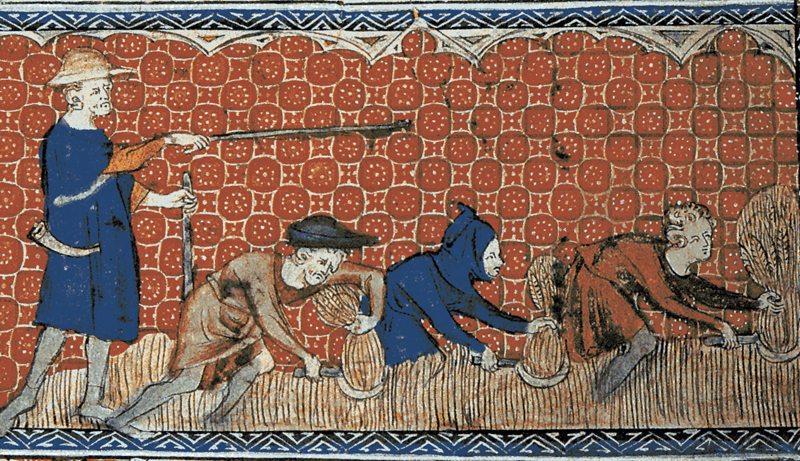
Men harvesting wheat, circa 1310

Men harvesting wheat, Queen Mary’s Psalter, circa 1310, public domain in the US

Message from His Royal Highness re: War College

To the fighters of Calontir, come these Greeting from His Highness, Sir Duncan Bruce of Logan regarding the upcoming War College event.

Unfortunately due to modern commitments, We will be unable to attend War College this year. However, We strongly encourage everyone who is able to go. This is one of the few opportunities for the army to practice together as a unit, and it should be taken advantage of. Please attend, and push each other to gain new skills and hone existing ones. You all performed well at Gulf Wars, but We can always get better.

We look forward to seeing all of you at Lilies War, where hopefully more practice at committing acts of violence will be had.

— HRH Logan —

The Passing of Lora Ann Ros of Dragon Rose

Lady Lora Ann Ros of Dragon Rose passed beyond the veil the evening of April 21st.  She is survived by her husband Friedrich von Blumenkamp and son Liam Drake.

The SCA found Lora Ann and Friedrich while they were vending at a Ren Faire. She was an honored member of the Barony of Lonely Tower until the family moved to Barony of Forgotten Sea a few years ago.

She enjoyed archery and bardic immensely, receiving a Golden Calon Swan for bardic and a Boga Fyrd in archery. She also enjoyed cooking and costuming, and was fiercely loyal to those she loved (and vocal!).

What she is probably most widely known for was her work with falcons. She once told the story that Friedrich woke her up one night and asked her if she realized that falconry was legal. She went back to sleep, knowing that there were birds in her future. She also worked with raptor recovery and nursed several birds back to health.

A memorial service is being planned by Lady Glenna Geis Garten, in Council Bluffs, IA, but date and other details are not available at this time. Lora Ann is being cremated in garb since she felt most of her happiest times were in the SCA.

UPDATE: The memorial for Donna Brooks (Lora Ann Ros) will be on May 6, 2016 at 3:00 pm at Cutler-Oneill Funeral Home located at 545 Willow Ave, Council Bluffs, IA 51503. The family has requested in lieu of flowers that you can make a donation to any cancer research fund or to Raptor Recovery Nebraska (http://raptor-dev.umn.edu/about/meet-our-birds/omaha).

Editors note:  Thanks to Lady Glenna Geis Garten

Lady Lora Ann Ros of Dragon Rose


Kingdom Arts & Sciences Court summary, April 09, A.S. 50

Osgar of Grimfells – Torse
Sabine of Carlsby – AoA
Rosie Haley – Queen’s Chalice
Hirakawa Kagetora – Leather Mallet
Melanie de la Tour – Golden Calon Swan

Other court news:
Jaida de Leon – new Kingdom Arts & Sciences Champion
Lillian Bowyer won the Judges’ Choice award
Paul Adler is the new Kingdom Minister of Arts & Sciences
6 people received Newcomer mugs
A boon was begged for Isengrim Sleggja to join the Order of the Laurel

Tutorial: Diamond Point Engraving

Reposted with permission from https://kaloethina.wordpress.com.


Original post appeared October 19, 2014

About a week ago, I posted photos of my Rose in Any Medium goblet entry that I did with diamond point engraving.  I also promised those in the Artisans of the Society for Creative Anachronism Facebook group that I would publish a tutorial on how to decorate glass with this technique.

Here’s what you will need:


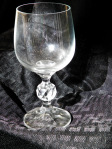
100_4986A glass object
(most engraved pieces in period were either goblets or plates.  I’ve had better luck with goblets, but your mileage may vary.  I purchase most of my glass for these projects at thrift stores, but I’ve also had luck finding cheap Libbey-ware at the dollar store.)

Permanent markers (I am fond of using multiple widths – I’ve got brush tips, fine tips, ultra-fine tips . . . they all work for this.  Do not use china markers for this project.  Repeat.  Do not use china markers for this project.  They will mess up your diamond tip.  Don’t ask me how I know.)

Rubbing alcohol (you’ll see why later!)


100_4987A diamond-point engraver
(these can be purchased from Ted Pella as a “diamond scribe,” and it may be more inexpensive to go with an angled tip and with a pair of pliers, gently shape into a straight scribe.  Originally made for the science industry, these are great for creating random bits of SCA pretty!)

Paper or low-lint fabric towels (again, you’ll see why later)

Safety glasses (you will be making glass chips.  Need I say more?)

Optional items

A plastic storage container, lined with soft material (mostly because I have found that this can be very taxing on hands, and well, glass is fragile)

A pencil grip (you are putting a lot of pressure on hands and fingers on a metal scribe, which fatigues the hands.  Using a pencil grip to help cushion may help you out)

Sketched art of common motifs as found in period and tape (if you have difficulties drawing, but can trace, this can help you out a lot)

Process

Ready to get started?  Excellent!


100_4992Step one:
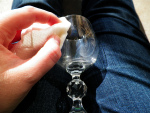
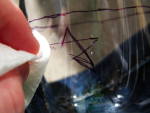
Use the rubbing alcohol and paper towels to clean your glass of any oils, gack, or china marking pencils (like my local thrift stores are fond of using).  You may also run your piece through the dishwasher, and then use the rubbing alcohol, but the key is to have a super-clean surface.  The reasoning for having a super-clean surface is so the engraver can stay in contact with the glass as you sketch your drawing onto it.  Also, take this time to inspect your piece.  It should have no bubbles, cracks, etc.  If it does, this can cause the piece to break while you’re working on it.

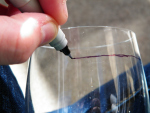
Step two: Take your permanent markers, and start sketching your design on the surface.  If you cannot
100_4995draw, tape art of your motif on the inside of the glass, and trace with the marker on the outside.  The downside of this method is that the design can become warped. When you do your layouts, remember that what you draw out will look frosted over, and while you can do hatching, it will look darker or different.
100_4997Do not worry if you make a mistake at this point.  Use your rubbing alcohol to clean up any mistakes and keep going – at this point, you’re doing your layout, and details may change from this point forward.  Also, do not worry if the ink comes off before you want – keep your permanent marker nearby and draw the detail back in.

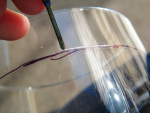
Step three: Put on your safety glasses, uncap your engraver, and start scratching away on your lines.  Every engraver has a “side,” meaning that there
100_5000 is a sharper side that will be easier to scratch with. Additionally, you will need to use some pressure, and this is truly the nerve-wracking part, as calibrating the proper amount of pressure takes practice.  You’ll also want to be able to wipe away glass chips as you go, as these can accumulate on the glass itself.  At this point, you’ll be scratching on the lines you’ve drawn on the outside.  Work until you’re happy with it.

Tips

For straight lines going around the glass, you can place your engraver on a pile of books or magazines, press down on the engraver, and rotate the glass.  However, depending on the thickness of your glass, this may or may not remove a well-formed ring of glass (which looks cool, yes, but shortens the glass and can create further issues, as the rim is now sharp).

Have spare glasses at the ready.  Breakage doesn’t happen often, but it is a risk.

Taking the Leap: Moving from Painting Preprints to Doing Original Scroll

Greetings again, Dear Readers! Time for the next installment of Scribe Stuff. This time, as promised, I will show you just how simple it is to move from doing a preprint scroll to completing a “real” original scroll. Spoiler Alert: It is a baby step.

You will need the following equipment:

  • Calligraphy pen
  • Paint
  • Brush/es
  • Water cup
  • Ruler
  • Compass or circle template
  • Graph Paper

The one thing I hear as a Scribe Laurel is “oh, I will help paint preprints, but I am nowhere near good enough to do a “real” scroll.” This is second only to “I don’t do calligraphy” or “I don’t do illumination” or “I can’t do calligraphy/illumination because….” All of the above are nonsense. You can do them, if you choose to learn and practice. Practice is key, just like any other skill. There are other keys and we will cover some of them here.

Another key is “There is almost NO difference between working on a preprint and doing an original scroll.” This is especially true if you have done the line artwork or calligraphy for a preprint scroll before. Regardless, there is no reason to continue only painting inside the lines of preprinted scrolls forever, unless that is all you truly want to do. IF you want to move forward and learn to start doing some original work, this is the place to start.

Reference my prior Falcon Banner article “What Does it Take to Start Doing Calligraphy and Illumination”

The basic materials are the same – a calligraphy pen (dip or cartridge), a right angle, a circle (circle template or compass), graph paper, and a liner pen (Micron, Rotring Art pen, crow quill dip pen). Add the paints, brushes and water you would use to paint inside the lines to color a preprint, plus some gold and an appropriate white liner, and you have the basic makings of an original scroll.
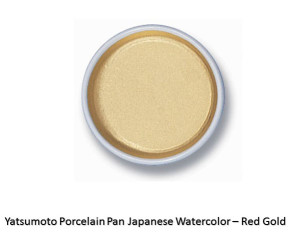
Yatsumoto Gold Watercolor Gouache in Ceramic PAn

Yatsumoto Gold Watercolor Gouache in Ceramic Pan – one of my personal favorite golds

There are some short cuts, which we will cover and some of which are even period to some extent. Cheating, by the way, IS period. After all, scribes of the Middle Ages simply copied text after text, making mistake upon mistake until we got documents essentially unrecognizable from the originals.

The start of a “real” scroll is exactly like that of a preprint, so refer to the Falcon Banner article for details. In short, I keep a sketchbook and a file folder of “good art” that I have done, others have done, inspiration material, etc. I have a resource list a mile long, Pinterest boards that are embarrassingly huge, and a library that could bankroll my retirement. There are a few essential books – such as Mark Drogin’s Medieval Calligraphy, which are absolutely required for calligraphers. The Craftsman’s Handbook by Cennini is another which I recommend you purchase early in your scribal career.
The Craftsmans Handbook - Cennini


I lay out the basics of the scroll – margins, space for artwork and space for text – first on graph paper. Then I find a font on the computer that approximates the one from period that I want to use. It may not have all the finery and so forth, but the roundness or lack thereof, the spacing of the letters, and the “time period feel” are all similar to that of the final scroll I envision. I play around with the scroll text in MS Word, using the font choices. I have spent too much time on the Internet, downloading and installing medieval styled fonts, so I have something like 200+ from which to choose.

I work with the text to get it sized, spaced (both words AND letters, as well as between lines) correctly for the space involved, and print it off underlined when it fits the final form. Why underlined? All the easier to line up with my graph paper, of course! Why make it harder?

I also increase the same font and change the font style to outline for any rubricated (decorated) capital letters that the scroll will include so they will match the text. I make sure these are the approximate size I need for the final scroll, and print these too.
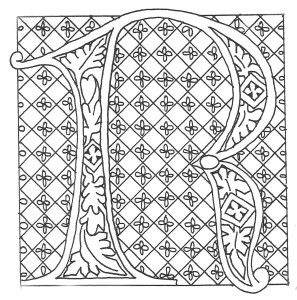
(c) Holly Cochran 2016

(c) Aidan Cocrinn OL, mka Holly Cochran 2016

In the end, I have balanced blocks of text as well as larger initials ready to be added to the graph paper rough draft. Remember – we are still in the phase that matches the preprint design stage exactly.

Next, I review my source books, online sources and stored drawings and other resources for inspiration and design elements appropriate to the text and time period. If there is an Order Badge to include in the design, I make the decision whether to include this as a badge per se or as the main charge (i.e. a Pelican) woven throughout the overall design. Either is appropriate for a GoA or Peerage scroll.

If I am using just the badge, I can print these directly from the Kingdom heralds page (Calontir Armorial – Awards and Badges).   This also has the individual armory of each person with a registered device in picture form as well as heraldese).  I call these sites my Electronic Apprentices.

I can download, save and desaturate (turn into black and white line drawings) any of the badges of Calontir awards, or of the various members of the populace. I can also save and print them as full color drawings. I can resize them until they fit the spaces of my design, print, then cut and paste into the graph paper rough draft.
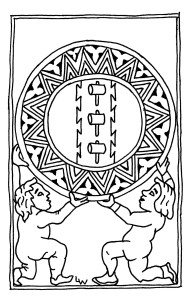
Mallet - Blank Border Art by Lucinda

Leather Mallet artwork by Lucinda Whyteland
® Lucinda Wilson 2016

Your rough draft, with its pasted text, badge, and possibly the recipient’s own device, is starting to look pretty rough indeed at this point. All is well. You are nearly done with this phase. All that is left is to connect the spaces between any large capital letters and the device or device motif.

This can be done with vine work (see WHEE demonstration and practice for tips on how to stay loose and make great circles and loops), Celtic knot work, diapered and gold-worked bar and ivy designs and more depending on the style of the scroll. The style must be consistent with the style and time frame of the text.

I often take inspiration from my various resource materials such as my personal collection of copies and books, as well as from online sources and additional research. I personally think it is important to make note that this work is based on, including the name of extant work/s from period either in a separate document attached to the scroll or written lightly in pencil on the back of the final scroll. The same goes for credit to the text writer.

Now is the place for your next major scroll hack or “cheat,” which is not really a cheat at all. Period scribes were known to trace – this is well documented. At times, they covered the back of their sketched work with colored chalky pigment, and then traced the design lightly using a stylus onto the “good paper.” Referencing the sketchbooks of Michelangelo, Durer and many others gives you an idea of just how much of this kind of transfer occurred.
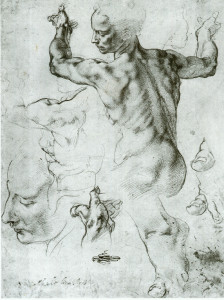
Michelangelo – Sketch for Sistine Chapel

Michelangelo – Sketch for Sistine Chapel

Another method used was to place the rough draft over the good piece of paper and trace over the design with a sharp pen or crown quill, or poke holes around the design to make indents where scroll text and design elements are intended. In period, scribes would use glass windows or tabletops, or they would use pins to prick the design throughout to use as a “connect the dots” method of tracing the image from rough draft to final page. Regardless of the method, short of photocopying one to the other, it is pretty much period. Using a glass-topped scribe’s desk with a low-heat emitting LED light-pad, I transfer the image from the rough draft to the “good” paper.

Once the design and calligraphy are transferred to the good paper, I use the ink calligraphy pen -mine is a Rotring Art pen, and the liner pen such as  the Rotring Art Pen sketch pen or the Micron liner pen, to trace the design onto the good paper. I have now essentially created the master copy of a preprint scroll, if this were not to be a Grant or Peerage level original scroll to award.

Once the black ink is very thoroughly dry, I can begin illumination work on the piece. I review my references once more, for colors and shading used and other things unique to that style of art. For instance – what was done in early Irish manuscript painting around 500-700 A.D. was not nearly the same as 1500-600 A.D. Ireland! One should never mix time periods that far apart. I keep mine within about 50 years of each other. Whenever possible, I refer to the original source. Online research libraries are a huge help for this – allowing us to see things we never saw before!
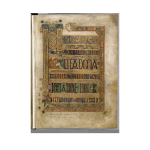
Book of Kells

Book of Kells

Illuminating my line-drawn design is no different from painting in a preprint. I use the same materials – gouache paint, for the most part, and gold gouache, leaf, or other gold supplies if needed for illumination, and a way to create white line, bar and ivy work as needed. I also work my paints to develop both a mid-tone as well as a light and dark tone for the colors in use, especially clothing drapery, faces, hair, etc.

Start with the gold work, as a rule. Other paints to do not stick to gold and you need to make absolutely sure the gold is done correctly. Learn to use either gold gouache, Sumi-e gold paint, or gold leaf techniques. None is particularly hard, but they are costly and time-consuming.

Once the gold is applied and trimmed so that the black lines around it show, I add the paint. I start with the lightest paint base colors and move towards darker shades as each element in the scroll is completed. The reasoning for this is simple – dark paint covers errors made with lighter paint. Trying to fix errors the other way ’round doesn’t work as well. I try to work around the scroll, completing one element or feature at a time, rather than doing “all the greens at once,” and then “all the reds” next.

Once all the initial layers of paint and calligraphy ink have dried, while the scroll is lying flat between two sheets of absorbent cotton or fiber towels (because, cats), I take the opportunity to clean up my workstation. I review my material and make sure the colors and design I used match with the text written and style desired by the recipient.

This is the time to add personalizing touches to the scroll. Is the recipient’s heraldry displayed somewhere? Do they belong to a household; are they also great at some other skills? Show those in the illumination, too. Add diaper patterns, highlights, low lights shading etc. to finish the scribery.
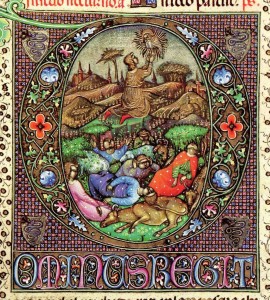
Elaborate piece from the Visconti Hours

Elaborate piece from the Visconti Hours


Finish up by cleaning up any messes on the scroll – a Q-trip dipped in bleach then gently rolled across the surface of the paper wonders for this. Be sure to blot the area with a dry paper towel to remove excess fluid and help dry the paper. When it is very dry, buff it out with a light application of the white rubber eraser to restore the “tooth” of the paper.

The very end phase, once everything is completely dried, is to spray a light coating of Workable Fixatif on the surface of the scroll. This product ensures minor drips of sweat will not ruin the scroll, nor impair the ability of Their Majesties to sign the thing before Court. Gently erase all pencil lines with the white rubber eraser before applying the spray. If a line or image drawing will not erase completely, do not worry and leave it be. Do not scrub at it and make the problem worse.

Do a final check of your work. Does it meet the requirements of the recipient, or their sponsor and the Order? Does the time period of the text agree with the time of the illumination? Is the badge of the Order correct? Are there places where the outline needs a touchup?

Now, walk away from the work for at least a day. Do not look at it. Do something completely non-scribal. Come back and look at the work with fresh eyes after a time. Recheck the work again, find any last fixes to fix – try those erasures again, clean up smudges, that sort of thing. Do not try to rework the illumination. At most, add a bit of white work if the illumination requires it, but nothing more than embellishments.

Add your maker’s mark to the front of the scroll and write “Scroll done by …” and your name in pencil on the back of the scroll. I like to add any sources I used, such as “based on the Lindisfarne Gospel, panels 9 and 22” or something like that. If someone else wrote the text, also write their credits on the back of the scroll in pencil.

Take at least one good quality photo of the scroll that shows the entire item. Also, take close up shots of any detail work. Start a portfolio of your work on your computer. Save the graph paper version rough draft of the scroll, and copy any favorite elements to your sketchbook or model book.
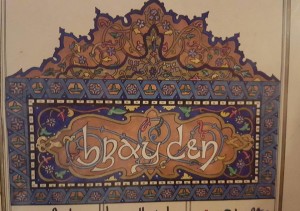
Best Scroll I've Ever Done I Think

Top Piece of Duchess Brayden’s Scroll                                                                (c) Aidan Cocrinn mka Holly Cochran 1993


Print 2 copies of the text in a simple typeface such as Arial or Calibri font, size 14 or so, one for the voice herald and one for the silent herald. Deliver the scroll and plain texts to the Royal Scribe.

Congratulations! You have completed a “Real Scroll” using nothing more than the skills you learned doing preprints.

Aidan Cocrinn, OL

55th Laurel of Calontir by the Grace of Conn and Sile

Royal Scribe to Their Majesties Matsunaga and Elena

First Cyborg Laurel of Calontir

Scribe Goob


Event Report – RUSH/Kingdom Scribe and Dance Symposium-Shire of Bellewood

April 2, A.S. 50 – Kirksville, MO

The Shire of Bellewood graciously allowed RUSH— the Royal University of Scir Havoc—to officially rebirth RUSH at their event. This turned the Kingdom Scribal and Dance Symposium into a full-blown RUSH event, with classes that included not only scribe and dancing but also a great many heraldry classes and round tables and a full track of cut and thrust classes and activities.

As this reporter was teaching scribal stuff all day, I cannot report first-hand on any of the other classes. However, RUSH Chancellor H.L. Cathus reported to me that the cut and thrust track was full all day long, and the heraldy classes were also well-attended.

On the scribal track, Mistress Jehanne Bening taught a class on how to safely use ground period pigments, which was well-attended and generated a lot of interest. A Scribes Guild meeting was hosted by Falcon Signet Mistress Elynor, as well.

The planned Ball and Grill in the park after classes had to be cancelled, due to unexpectedly cold and very windy conditions. Because We are Calontir, we adapted and overcame by holding the ball on the third floor of the site and ordering mass quantities of pizza. The musicians and dancers had great fun, as did those who chose to merely observe and dine.

Opposite this event was also Spring Spears, attended by Her Majesty, the Fyrd Retreat and Lilies Site Cleanup Day, and His Majesty’s personal birthday held in an undisclosed location. The St. Louis ComicCon also drew people in other directions. In spite of all that, attendance at Bellewood was excellent.

All in all, attendees and instructors seemed to agree the day was a great success. We are looking forward to more RUSH classes at Lilies War, followed by a RUSH event in early November 2016 in the Shire of Carlsby

Mistress Aidan Cocrinn

January 2016 LOAR Results

Greetings to All,

Below are the results of this LOAR.

The Armorial and Saker website will be updated this evening to reflect the items in this letter.

In Service,

Gunnar Thorisson

Vert Hawk Herald

CALONTIR acceptances
* Cecilia Manetti da Firenze.  Reblazon of device. Per bend sinister vert and gules, a bend sinister between a mouse sejant erect and a pair of manacles, the chain fracted argent.
Blazoned when registered in January 1998 as Per bend vert and gules, a bend between a mouse sejant erect and a pair of manacles, the chain fracted argent, this is actually a per bend sinister field with a bend sinister.
* Cuthbert Longschankes.  Device (see RETURNS for badge). Per pale azure and Or, on a roundel counterchanged an owl argent.
* Eynon ab Iohannes Mal.  Device. Azure, a demi-sheep argent issuant from a bickern maintaining in its mouth a falchion bendwise inverted Or and a chief Or crusily azure.* Hubert de Stockleye.  Name change from Wulfhere of Eofeshamme.
The submitted requested authenticity for 13th-14th century England. This name is authentic for the 1270s, meeting the submitter’s request.
The submitter’s previous name, Wulfhere of Eofeshamme, is retained as an alternate name.* Isabeau Ruiz.  Name.* Katherine von Heilige.  Name change from holding name Katherine of Forgotten Sea.
Submitted as Katherine die Heilige, this name was pended to discuss whether this name presumed upon the name of Saint Catherine, especially due to the use of the demi-Catherine’s wheel in the submitter’s device.
Saints are occasionally referred to by [given name] die Heilige in modern German, although the reverse order (die Heilige [given name] appears more frequently. The use of die Heilige (“the saint”) is presumptuous under PN4D1 of SENA, as this name appears to make a claim to be the historical St. Catherine. We note that unmarked forms like Heylig and von den Heiligen are not presumptuous because they are attested as the bynames of non-saints in our period.
The submitter allowed a change to the attested byname von Heilige (based on Von Heilige, found in the FamilySearch Historical Records). We have made this change. If she prefers Heylig (or other attested unmarked form) or von den Heiligen, she can submit a request for reconsideration.
This name was pended from the August 2015 Letter of Acceptances and Returns.

* Kezia von Holzenhaus.  Badge. Argent, a billet and a bordure sable.

* Layla bint `Asim.  Name and device. Azure, in fess a mullet and a decrescent Or, a bordure wavy argent.
Please advise the submitter to draw deeper waves on the bordure and the primary charges larger so they fill better the available space.

* Mell MacAlpin.  Badge. (Fieldless) A snail gules attired and shelled Or.
* Mell MacAlpin.  Badge. Per fess embattled azure and Or, in chief three buckets inverted argent.
* Mell MacAlpin.  Badge. Per pale Or and gules, two dragon’s heads couped addorsed counterchanged.
This is the submitter’s sixth piece of registered armory.

* Miranda de Logan.  Name (see RETURNS for device).
Miranda is the submitter’s legal given name. We note that it is also a grey period English literary name. Recently, we ruled the following:
Miranda is the submitter’s legal given name as well as the name of a gray area literary character from Shakespeare’s Tempest and a late 16th century English byname which can be registered as a given name. Therefore, the submitter need not rely on the legal name allowance. [Miranda Mór ingen Fhailtigern, June 2015, A-An Tir]
The instance of Miranda as a late period English byname in that decision inadvertently relied on an I-batch in the FamilySearch Historical Records. I batches continue to be acceptable only on a case-by-case basis, and should not be used as the sole documentation to support a name element.
Therefore, as Miranda does not appear to have been coined until after 1600, the submitter must rely upon the legal name allowance.

* Rianorix of Forgotten Sea.  Name.
Forgotten Sea is the registered name of an SCA branch.

* Thaddeus Ellenbach.  Name (see RETURNS for device).
Submitted as Thadeus Ellenbach, the submitter requested the spelling Thaddeus Ellenbach if it could be documented. The preferred spelling is found in Historia und Christliche Legenden, von der heiligen zwölff Apostel unsers Herrn Jesu Christi, Item von S. Pauli, auch beider heiligen Euangelisten S. Luce und S. Marci, beruff, lehre, leben, wunderwercken, letzten marter und todt, ob standhaffter bekandtnuß des Namens Christi, published in 1589 (https://books.google.com/books?id=20pWAAAAcAAJ&pg=PT529). Therefore, we have changed the given name to this form.

* Theodoric Rufus the Goth.  Reblazon of device. Sable, a sea-lion naiant and in base three pheons two and one argent.
Blazoned when registered in June 1995 as Sable, in pale a sea-lion naiant and three pheons two and one argent, the sea-lion is the sole primary charge.

* Umm Razin Rusa al-Badawiyya.  Name and device. Per fess azure and vert, a chevron couched from sinister and in canton a decrescent argent.

* Zachariah MacDonald.  Name change from Zachariah Lochrie.
The submitter’s previous name, Zachariah Lochrie, is retained as an alternate name.

CALONTIR returns
* Ann O’Carolan.  Badge. (Fieldless) A sword argent and overall a wolf’s head erased contourny azure.
This badge is returned for redraw. Please instruct the submitter on the proper way to draw erasing: either three or four prominent, pointed jags on the erasing, as described on the Cover Letter to the November 2001 LoAR:
Therefore, for purposes of recreating period armorial style for erasing, the erasing should (1) have between three and eight jags; (2) have jags that are approximately one-sixth to one-third the total height of the charge being erased; and (3) have jags that are not straight but rather are wavy or curved.
Alternatively, the submitter could decide to resubmit the overall charge as wolf’s head couped.* Cuthbert Longschankes.  Badge. (Fieldless) A Celtic cross Or irradiated azure.
This badge is returned for not being reliably blazonable, which is a violation of SENA A1C which requires an emblazon to be describable in heraldic terms. Blazoned as a Celtic cross irradiated, irradiation would surround the entire charge and would leave no gaps between the azure extensions. It cannot be blazoned as a mullet of eight points azure with a Celtic cross Or surmounting it as there is no way to blazon the exact overlap of the center of the mullet with the junction point of the cross.* Miranda de Logan.  Device. Azure, a snake headed at each end annodated palewise and on a chief Or, three mullets of eight points azure.
Blazoned on the LoI as palewise counterembowed-embowed, the snake’s posture can only be described as what Parker’s Glossary, p.11, defines as annodated: “bowed embowed, or bent in the form of the letter S.” No documentation was provided by the submitter or in commentary for the period use of this posture in snakes. Thus this device is returned for running afoul of SENA A2C1 which states “Elements must be drawn in their period forms and in a period armorial style.” Additionally, this posture renders the snake difficult to identify and many commenters confused it with a letter S.* Thaddeus Ellenbach.  Device. Lozengy azure and argent, a lion contourny Or maintaining a sword proper, a bordure sable.
This device must be returned for insufficient contrast between the held charge and the field.
Per SENA A3B4a:
Placement of Charges: Charges must have good contrast with the background on which they are placed. Primary, secondary, and overall charge groups are considered to be placed on the field and must have good contrast with it.

While technically this armory has a neutral field, the mostly argent sword lying nearly entirely on argent lozenges of the field has insufficient contrast.

Five Decades of Art History from the Metropolitan Museum of Art Now Free

The Metropolitan Museum of Art has made available over 450 publications on art history, stretching back over 50 years. The publications appear to be available as downloadable PDF files,  viewable online (Google Books) or print on demand.  http://www.metmuseum.org/art/metpublications/titles-with-full-text-online?searchtype=F&rpp=12&pg=1


http://www.metmuseum.org/art/metpublications/titles-with-full-text-online?searchtype=F&rpp=12&pg=1

Crown Tournament Court summary, March 26, A.S. 50

On the tourney field:
A boon was begged for Valdríkr inn Danski to be elevated to the Chivalry
Vakri Valdrickrsson – Iren Hirth

Update:  Sir Duncan Bruce of Logan and Mistress Ylva Jonsdottir were named Heirs to the Falcon Throne.  (Please forgive this omission.  My aged brain told me that since this news had been announced in a previous post to the Falcon Banner, it didn’t need to be repeated here.  Of course, my aged brain was mistaken.  <insert embarrassed emoticon here>)

In evening court:
Saito Takauji is the new Gold Falcon Principal Herald
Konstantia Kaloethina was created a Herald Extraordinary
Lucrezia Contarini – AoA
Alexander Baton – AoA
Chrystopher Wotjowicz – Leather Mallet
Michael Eriksson – King’s Favor, AoA

Other court news:
Crystal Mynes presented largess
Ameline de Coity won the Rose in Any Medium competition
Antonia Stefani – 1st place in the Largess competition
Kathryn Dagget – 2nd place in the Largess competition
13 people received Newcomer mugs, 4 of them were children
Dani of Oakheart and Freya won prizes in the Children’s Activities egg hunt