Life Before Toilet Paper

Reposted from the East Kingdom Gazette:


Arts & Sciences Research Paper #7: Life Before Toilet Paper


Life Before Toilet Paper

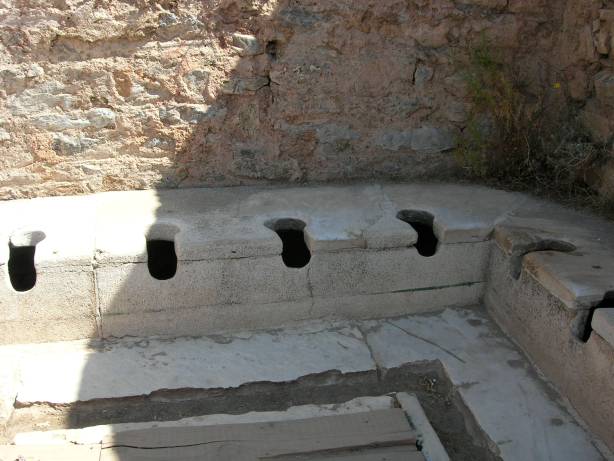
Ancient public toilets in Ephesus

Ancient public toilets in Ephesus


There are some things in our society that are so basic, so integral to our lives that we cannot imagine going without.  Toilet paper is one of these items.  Since 1857, when toilet paper first became commercially available, we have used it to cleanse after using the bathroom.  This begs the question; what did people use to clean themselves before toilet paper?  This work will provide an overview of what people used to cleanse themselves after defecating in Rome, China, Japan, India, the Islamic states and various areas of Europe between 400 C.E. and 1600 C.E.

Contents
Rome
Buddhist Precepts for Monks in India
Islamic Precepts for Worshippers
Japan
Western Europe
China
Bibliography
Notes

Rome
We begin in Rome, in the communal toilets adjacent to the city’s bathhouses.  These communal bathrooms were semi-circular or rectangular rooms containing long benches along the walls, with individual round spaces carved into them.  Running water flowed underneath them to wash away the waste.  According to William E. Dunstan in his book Ancient Rome, “Public latrines, though often lavishly decorated with statuary and singing fountains, proved dimly lit and poorly ventilated.  They became overcrowded retreats for the unprivileged living in multistory tenements lacking toilets.” [1]

Lucius Annaeus Seneca, in his series of letters known as Moral Letters to Lucilius references a sponge affixed to a stick as being used for cleansing after defecating.  In his 70th letter, he relates a tale of suicide in which this implement, commonly referred to by scholars as a spongia, played a pivotal role.  “A captured German, who was making ready for the morning exhibition, withdrew in order to relieve himself, the only thing he was allowed to do in secret and without the presence of a guard.  While so engaged, he seized the stick of wood, tipped with a sponge, which was devoted to the vilest uses, and stuffed it, just as it was, down his throat…”[2]  To date, there appears to be no other specific reference to the spongia in ancient text.

Sources speculate that the spongia would be stored in either a bucket of salt water, or would be placed in front of the public toilet in a stream of running water that ran in front of the commode in communal bathrooms.  These spongia were used by everyone who utilized the public toilets.

The Roman elite used chamber pots or toilets within their own homes instead of using the communal commodes whenever possible.  Instead of the spongia, it is conjectured that they cleansed with rosewater and soft wool while in their homes.[3]
Back to Top

Buddhist Precepts for Monks in India
We move from Rome to India, where Buddhist monks were fastidious about cleanliness.  So fastidious, in fact, that they had very particular rules regarding the use of the bathroom.  These rules are outlined, in detail, in early versions of the Vinaya Pitaka, the Buddhist canonical for monks.  Each of the seventeen rules were to be followed each time one used the toilet facility.

  1. One should not defecate outside of the cesspool.
  2. While standing outside, one should clear his throat.
  3. Anyone sitting inside should also clear his throat.
  4. Having put aside the (upper) robe on a bamboo pole or a cord, one should enter the place properly and unhurriedly.
  5. One should not pull up one’s lower robe before entering.
  6. One should pull up one’s lower robe while standing on the toilet shoes.
  7. If the place is splattered it should be washed.
  8. One should not groan or grunt while defecating.
  9. One should not wipe oneself with a rough stick.
  10. One should not drop the wiping stick into the cesspool.
  11. If the basket for wiping sticks is full, the wiping sticks should be thrown away.
  12. One should then cover oneself (with one’s lower robe) while standing on the toilet shoes.
  13. One should not leave hurriedly.
  14. One should not leave with one’s lower robe pulled up.
  15. One should pull it up while standing on the rinsing-room shoes.
  16. One shouldn’t make a smacking sound while rinsing.
  17. One should not leave any water remaining in the rinse vessel.[4]

Further evidence to the Buddhist doctrine of cleansing after defecation is found in an anecdote within their guidelines for monks which tells a story of the consequences of not rinsing oneself after defecating:

“Now at that time a certain bhikkhu, a brahman by birth, didn’t want to rinse himself after defecating, (thinking,) ‘Who would touch this vile, stinking stuff?’ A worm took up residence in his anus. So he told this matter to the bhikkhus. ‘You mean you don’t rinse yourself after defecating?’ (they asked). ‘That’s right, my friends.’ Those bhikkhus who were of few wants … criticized and complained and spread it about, ‘How can a bhikkhu not rinse himself after defecating?’  They reported this matter to the Blessed One…”[5]

The monks utilized what they referred to as a wiping stick to scrape feces after defecating.  The stick was smooth and slightly rounded, and was used to remove large pieces of feces before the monks rinsed themselves with water.
Back to Top

Islamic Precepts for Worshippers
Buddhism is not the only religion that has strict rules about personal hygiene.  Worshippers of Islam had similarly stringent requirements for cleanliness.  The Qur’an is adamant about personal hygiene, which is why it is not surprising that Muslims also had very specific rules when it came to cleansing after defecation.  Abu Hureyrah, companion to the prophet Muhammad, narrated many edicts to the followers of Islam; cleansing after defecation included, between 590 and Muhammad’s death in 632 C.E.  “When any one of you goes to the Gha’it (toilet to defecate), let him take with him three stones and clean himself with them, for that will suffice him.”[6] He also stated, “I never saw the Messenger of Allah come out of the toilet without first (cleansing himself) with water.”[7]

Rules, based on the narrations of Abu Hureyah, are outlined in Qadaa’ Al Haajah.  A redacted set of these rules is itemized below.

  1. When entering the toilet, one should say the A’udhu (isti’adha) and Basmalaand then recite a prayer.
  2. When entering the toilet, one should not have in one’s hand anything on which the name of Allahu ta’ala or any verse of the Qur’an al-karim is written.
  3. One should enter the toilet with one’s left foot and exit with one’s right foot.
  4. One should recite the prayer “Alhamdu-lil-laa-hil-la-dhi adh-haba ‘a-nil a-dhaa wa ‘a-faa-ni” when exiting the toilet.
  5. After cleaning one’s private parts, one should cover them immediately.
  6. One should neither face the Qibla nor turn one’s back toward it while urinating or defecating.
  7. One should remove the feces on one’s anus with one’s finger and wash one’s hand. If there are still traces of filth, one should wash them with water.
  8. One should dry one’s private parts with a cloth after washing them.
  9. One should not look at one’s private parts or spit into the toilet.
  10. One must not urinate into any water, on a wall of a mosque, in a cemetery, or on a road.
  11. Cleaning the private parts with stones and similar materials is an acceptable substitute for cleaning them with water.[8]

One will note that the process of cleaning oneself after defecating is specifically addressed.  The utilization of one’s own hand appears to be the preferred method, followed by rinsing and washing the hand.
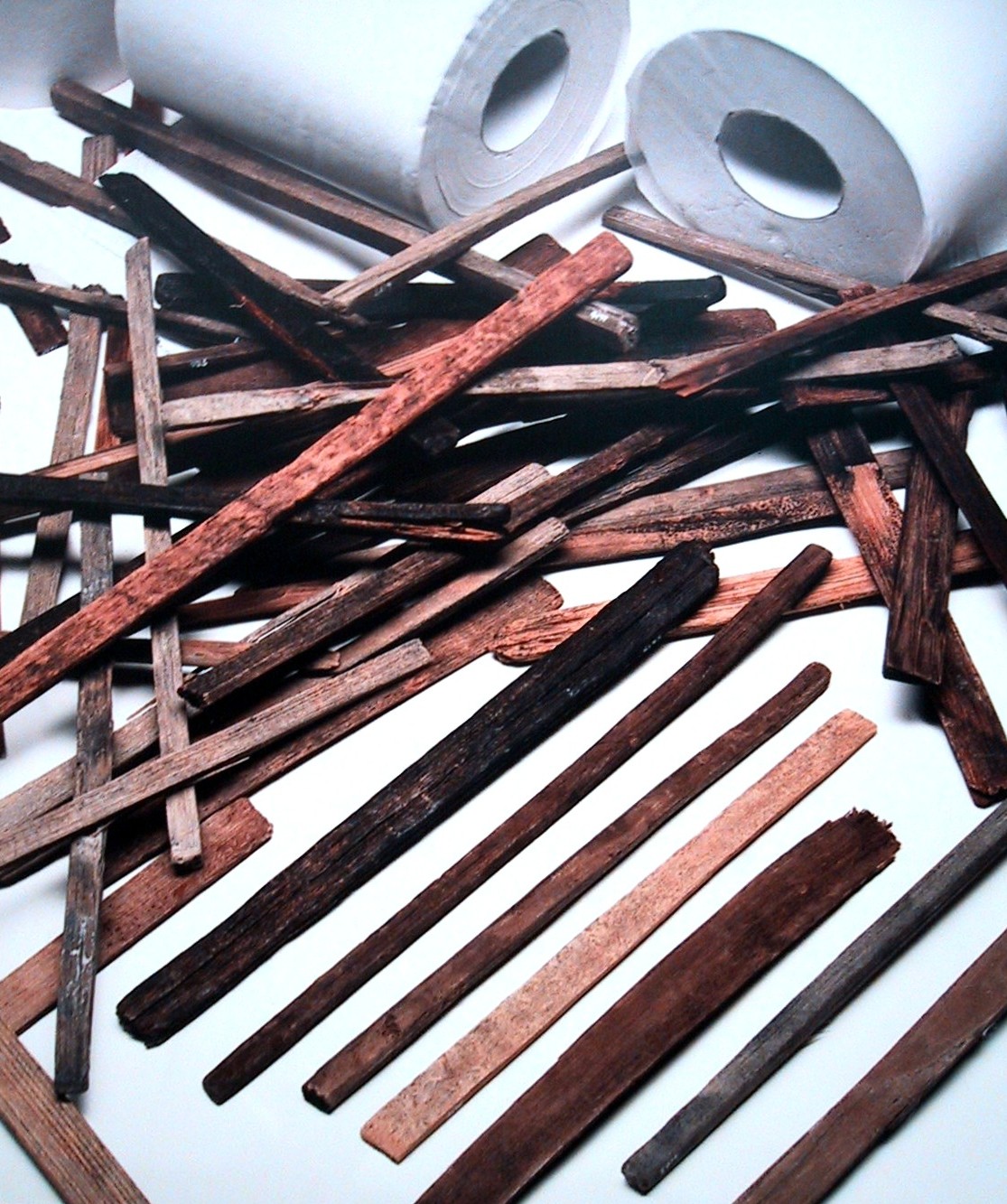
 

Japanese wiping sticks. This Wikipedia and Wikimedia Commons image is from the user Chris 73 and is freely available at //commons.wikimedia.org/wiki/File:Nara_period_toilet_paper.jpg under the creative commons cc-by-sa 3.0 license.

Japanese wiping sticks.

Back to Top

Japan
The Japanese, like the Indian Buddhists, used sticks to clean themselves after defecating.  Flat, rounded sticks, called chu-gi, were uncovered in ancient cisterns dating as far back as 750 in the ancient Japanese capital of Nara.  During what is called the Nara Period, between 710 and 784, the capital had 10-15cm trenches dug and water diverted through them, making a drainage system.  Citizens would squat over these trenches, with a foot on each bank of the trench to urinate and defecate; the waste being washed away from the city.  The dirty sticks would be washed in the running water, and retained for future use, or dropped in the trench for disposal.[9]
Back to Top

Western Europe
In Western Europe, materials available for sanitation varied based on your wealth and social standing.  It is conjectured that rags were used throughout Europe and were the most common materials used for anal cleansing.  Ronald H. Blumer states his work entitled Wiped:  The Curious History of Toilet Paperthat clothing too threadbare to be worn would be utilized for anal cleansing repeatedly until it was no longer fit for that purpose as well.[10]  Archeological digs under monasteries in Europe have found remnants of the tattered, holey rags used by monks and nuns for toilet purposes.  Finer wools and linens worn by the elite were used for their sanitary needs once they were no longer suitable to be worn as clothing.

Not everyone used rags, however.  In the household records of Duc de Berry in 1400, for example, there is reference to quantities of flax and hemp being purchased in a raw, unspun state for the express purpose of anal cleansing.[11]  And though few household records like these have survived, literature has.  Toilet humor–also known as scatological humor–is not a wholly modern notion.  La vie de Gargantua et de Pantagruel, written by François Rabelais between 1532 and 1564, was full of scatological humor.  Chapter 1.XIII, “How Gargantua’s wonderful understanding became known to his father Grangousier, by the invention of a torchecul or wipebreech” is a perfect example.  This chapter of the famous work is solely dedicated to the discussion of anal wiping:

“I have, answered Gargantua, by a long and curious experience, found out a means to wipe my bum, the most lordly, the most excellent, and the most convenient that was ever seen.  What is that? said Grangousier, how is it?  I will tell you by-and-by, said Gargantua.  Once I did wipe me with a gentle-woman’s velvet mask, and found it to be good; for the softness of the silk was very voluptuous and pleasant to my fundament.  Another time with one of their hoods, and in like manner that was comfortable.  At another time with a lady’s neckerchief, and after that I wiped me with some ear-pieces of hers made of crimson satin, but there was such a number of golden spangles in them (turdy round things, a pox take them) that they fetched away all the skin of my tail with a vengeance.  Now I wish St. Antony’s fire burn the bum-gut of the goldsmith that made them, and of her that wore them!  This hurt I cured by wiping myself with a page’s cap, garnished with a feather in the Switzers’ fashion.

“Afterwards, in dunging behind a bush, I found a March-cat, and with it I wiped my breech, but her claws were so sharp that they scratched and exulcerated all my perinee.  Of this I recovered the next morning thereafter, by wiping myself with my mother’s gloves, of a most excellent perfume and scent of the Arabian Benin.  After that I wiped me with sage, with fennel, with anet, with marjoram, with roses, with goud-leaves, with beets, with colewort, with leaves of the vine tree, with mallows, wool-blade, which is a tail-scarlet, with lettuce and with spinach leaves.”[12]

By the end of his diatribe, there is seemingly nothing that the young man won’t use.  In fact, when he comes to wiping with paper, he has this to say, “Who his foul tail with paper wipes, Shall at his ballocks leave some chips.”[13]

Though a humorous work of fiction, it does provide insight to what might have been used for anal cleansing.  The author is clearly utilizing the absurd in the name of his art, but it is not unreasonable to take grains of truth from the document.  It is quite likely that leaves, moss, straw, discarded pieces of clothing, etc. would have been utilized by all walks of life depending upon their region and the materials available to them.

It is suggested in numerous works on the subject that leaves, moss, shells, and the like would have been used for cleaning after defecation, though none of these works have been able to provide evidence to support their assertions.  It is not unreasonable, however, to make such a conjecture.  A soft leaf, unspun wool, and straw would have proved to be useful if no other means of cleansing were available.
Back to Top

China
While their Western counterparts were using leaves, rags, or sponges soaked in saltwater, and other areas of Asia were using sticks to clean their anuses, the Chinese were manufacturing paper to address their sanitary needs.  There is little written on the invention, manufacture, and use of the predecessor to the modern toilet paper, but there is mention of paper being used in the eliminatory process as far back as the first century.  Joseph Needham, in his collection of works entitled The Science and Civilisation of China, cited that the Chinese used paper made from rice straw for sanitary purposes.  Chinese scholar Yan Zhitu stated in 589 that “paper on which there are quotations or commentaries from Five Classics or the names of sages, I dare not use for toilet purposes.”  Additionally, an Arab explorer during the Tang Dynasty, is noted as having stated “They [the Chinese] are not careful about cleanliness, and they do not wash themselves with water after they have done their necessities, but they only wipe themselves with paper” in his memoirs detailing his travels to China.[14]

The Chinese eventually began manufacturing a specific type of paper to use after defecation, known as tshao chih.  According to Chinese records maintained by the Imperial Bureau of Supplies, over 720,000 sheets of tshao chih were manufactured in 1393 alone.   The imperial family, however, received “…15,000 sheets, three inches square, light yellow, thick but soft, and perfumed.”[15]  In fact, the use of tshao chih was so prevalent, Zhejiang Province (aka Chekiang Province) alone used ten million packages of 1,000 to 10,000 sheets in 1393 for its population of 2,138,225.[16]

Until the 19th century, paper was made exclusively by hand, and therefore, was more expensive to procure.  It would have been more cost effective to use materials that were readily available, such as leaves and old rags instead of paper.  As paper became easier and less expensive to manufacture, its use for cleansing after defecating became more common and eventually took its place as the preferred method for cleaning in most parts of the known world.  Today it is estimated that modern Americans use approximately 100 rolls of toilet paper per year.  With nearly 390,000,000 people in the US, Americans use 39,000,000,000 rolls of toilet paper each year.
Back to Top

Bibliography

Bennett, Howard. “EVER WONDERED about the history of toilet paper?” The Washington Post (2009): 1-2.  Accessed 10/27/2014.

Bhikkhu, Thannissaro, ed.,  The Buddhist Monastic Code II. Thanissaro Bhikkhu, 2001.

Blumer, Ronald, H. Wiped:  The Curious History of Toilet Paper.  CreateSpace Independent Publishing Platform; 2nd edition, 2013

Chavez, Amy “From the ditches of nara to the Otohime, a lav story” The Japan Times (2014): Accessed 12/27/2015

Dunstan, William E. Ancient Rome. Plymouth: Rowman & Littlefield Publishers, Inc., 2011.

Guanglin Liu, William. The Chinese Market Economy, 1000-1500.  Albany, NY: State University of New York Press (2015).

My Religion Islamic. “Islamic Toilet Etiquette” (2015):  Accessed 12/28/2015

Needham, Joseph. Science and Civilisation in China, Vol. 5, Part 1:  Cambridge:  Cambridge University Press, 1954.

Rabelais, Francois; Translation by Sir Thomas Urquhart of Cromarty. Gargantua et de Pantagruel: 1653

Schofield, Hugh. “Filthy secrets of medieval toilets” BBC News (2003):  Accessed 10/27/2014

Seneca, Lucius Annaeus. “Moral letters to Lucilius” Letter 70 :  Accessed 02/15/2016

“The Hadith of the Prophet Muhammad at Your Fingertips”: Accessed 02/15/2016

“Islamic Toilet Etiquette“: Accessed 02/15/2016
Back to Top

Notes

[1] Dunstan, William E. Ancient Rome, pg 359.

[2] “Moral letters to Lucilius/Letter 70”

[3] Dunstan, 359

[4]Bhikkhu, Thannissaro, ed.,  The Buddhist Monastic Code II, pg. 108

[5] Ibid, pg. 107.

[6] Vol. 1, Book 1, Hadith 44 

[7] Vol. 1, Book 1, Hadith 354

[8] “Islamic Toilet Etiquette“ 

[9] Chavez, Amy “From the ditches of Nara to the Otohime, a lav story” The Japan Times

[10] Blumer, Ronald, H. Wiped:  The Curious History of Toilet Paper

[11] Ibid

[12] Rabelais, Francois, La vie de Gargantua et de Pantagruel Chapter 1.XIII

[13] Ibid, pg 78.

[14] Needham, Joseph Science and Civilisation in China, Vol. 5, Part 1

[15] Needham, 123

[16] Guanglin Liu, William The Chinese Market Economy, 1000-1500, p 13 Appendix A
 

Halvgrimr’s Hall: a Viking Age Hoard of Information

Halvgrimr’s Hall is a Facebook blog page with the stated purpose “A blog where I intend to document my attempts at Living Heroically both in and outside my hobby. I hope my efforts inspire others to do so as well.”

The blog covers many areas of Viking Age reenactment, but most prominent is the extensive research and discussion regarding finds of helmets of the period. Extensive articles on the Vendel Helmet 14, the Sutton Hoo helmet, and pointers to resources for further research are just a few of the items available.

Halvgrimr says he also does “a weekly coverage piece on various ‘Viking Age’ helms and I hope to keep that running even after I run out of extant pieces”

If you are interested in Viking Age research, and especially extant helms, but sure to check out Halvgrimr’s Hall.

Scribe 101: What Does It Take To Start Doing Calligraphy and Illumination

Most of you, Dear Readers, won’t believe me when I say the basic materials for starting your career as a scribe are incredibly minimal. Primitive, perhaps, is a more apt word.

Many protest they cannot Scribe because their handwriting is horrific and they have no artistic skill. Handwriting is irrelevant, as is your artistic talent and even whether you are left or right handed. What matters is the willingness to learn and practice, openness to trying a new skill and the ability to understand the difference between handwriting and the Scribal Arts.

I’ve been doing this for more years than I’d care to admit. In a pinch, it takes very little to draw pretty letters and make a decent-looking scroll, even under less than ideal conditions. One of my articles down the road will cover “Combat Scribing: The Art and Science of Doing a Scroll under Horrible Conditions.” This is also known as doing a last minute scroll at Lilies War.

My Rolling Scribe Box looks just like this, except it is camo green.

My Rolling Scribe Box looks just like this, except it is camo green.

You do not need my rolling Scribe Box of Wonders, plus a home scribe room full of more cool stuff to do scrolls. At some point, more stuff becomes a distraction. We will start with the bare basics. This series will build from there. Eventually, you will find personal favorites to add to your Kit, as well finding things you feel convenient or helpful beyond the basics.

The Scribe’s Library will grow, too. Invest in Amazon Prime, and learn to scour every method of acquiring good quality used books, as well. Bargain shopping for books will serve you well for your entire Scribe career.

At the end of this article, I list some online resource and essential Scribe books. Always seek online coupon and discount codes before shopping. Free shipping is the most common. Some merchants have begun to recognize the SCA as a significant constituent and offer an SCA discount at checkout. Ask for it. Join all the SCA Scribes related Facebook groups you can find, and get hooked on Pinterest Scribe boards for more online inspiration and resource generators.

Even a few decades ago, these resources were not available, yet now they are lifesavers. Find the online digitized manuscript treasuries and bookmark them. Take classes at RUSH (Royal University of Scir-Havoc) or elsewhere, plus ask a more experienced Scribe if you can sit with them and ask questions. After all, most Scribal Arts are done alone, at home, in our workshops. It is much akin to raising small children– after a while; Scribes long for adult conversation!

Scribe MAterials

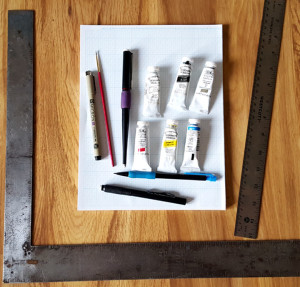
Bare Bones Scribe Materials

Shown above – a right-angle, a straight edge, graph paper, a calligraphy pen, a liner pen, a pencil, a white eraser, a paint brush, and gouache in the three primary colours (red, blue, yellow), plus zinc white, lamp black and gold.

The materials pictured above, with the addition of an un-wobbly workspace, light, a water cup, a palette for mixing paint and the final scroll paper of the Scribe’s choice, are the bare minimum requirements for being a scribe. True story.   There are many other pleasant, helpful, and nifty things a Scribe can use to create lovely scrolls. The things in the photo, however, produce just as beautiful a scroll when used to correct effect.

Let us begin.

Calligraphy is not handwriting.

Calligraphy is drawing letters. For this reason, your handwriting matters not, nor does your dominant hand. Practicing on graph paper is the single best way to learn calligraphy, learn it correctly and of getting it right, I have ever discovered. Use the cheapest Dollar Store on sale graph paper imaginable and achieve the same muscle-memory excellence as if you purchased specialty “practice paper” from an art store. Save your money, buy the cheap graph paper.

I taught myself to do calligraphy left handed simply to be able to teach lefties. There are left-handed calligraphy nibs and right-handed nibs. Please purchase the ones appropriate to your handed-ness. It truly helps.

Using a calligraphy pen to draw letters involves following the strokes indicated in a teaching manual for calligraphy. I recommend a beginner book such as Medieval Calligraphy: Its History and Technique by Marc Drogin. This shows a variety of scripts and breaks them down stroke by stroke. It also shows the exact pen-tip (nib) placement, letter height, and historical examples of each script. Many other beginner texts exist, too. The Drogin book is just one of the better known and most available.

Illumination does not require artistic talent.

Illumination requires the ability to use basic tools such as a straight edge, and the ability to create a model book or exemplar from doodles and period works. A sketchbook of your best doodles, photocopies of the devices of the Kingdom awards, various heraldic animals, Celtic knot work, swirly vines and acanthus leaves, fancy illuminated initials and so forth, will be your best travel companion. Bored at Court? Sketch. Sketch letters, designs, things you have seen. Practice that Tudor Rose or another motif you saw at the event.

Celtic knot work, the subject of a later article, is merely drafting and dots, by the way. Do not be intimidated. It is ridiculously easy once you know the tricks. After all, if we Irish could do it, anyone can do it. Look online at Michelangelo’s sketchbooks. They were designed to get the proportions and placement of his figures correct, not to be as beautiful as his finished work. When called upon to create a scroll, you will have an idea book of sketches and designs ready.

Illumination also requires the ability to manipulate a paintbrush and to color within the lines. Most of us learned these skills in primary school. We perfect these through practice. Practice is widely available in the Calontir Scribal world by helping the Royal Scribe paint pre-print scrolls. These are scrolls in which the calligraphy and line art for the illumination has already been done by another Scribe, and then photocopied onto heavyweight paper. Beginning (and sometimes also advanced) Illuminators paint the preprints using gouache paint, just as they would paint an original scroll.

What is gouache?

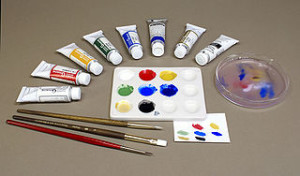
Gouache is opaque watercolour, created by combining finely ground pigment with binders and then either partially dried and stored in a tube, or completely dried into a pan. The colors in my photo above are Windsor and Newton Artists Gouache. Many of the Windsor and Newton line use period pigments and binders such as gum Arabic. Some period pigments, such as Lead White, are also available\ and come with safety warnings.

Gouache

You can also use regular transparent watercolour on a scroll. I used authentic Japanese-made watercolours when creating both His Majesty’s Chivalry scroll and Uji-Two’s Torse scroll. They work well. Chinese ink stick colors work well, too. Some calligraphy-specific coloured inks give good colour to scrolls. Personally, I avoid acrylic or oil colour for basic SCA scrolls. They may be appropriate for some kinds of non-traditional scrolls, however.

A word about calligraphy pens

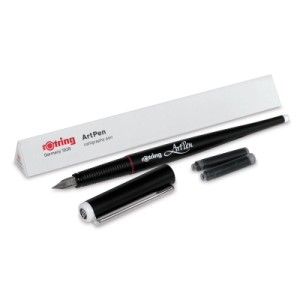
Yes, Dear Readers, I use a cartridge pen for 99% of my scroll work. I do this for several reasons. The pen I use is a Rotring Art Pen. It contains archival quality ink, fits nicely in my arthritic hand, and is  completely reliable. The stainless steel nibs refuse to die. When I packed up from the Barony of al-Barran in the Outlands 10 years ago, I left ink cartridges in the pens. There they stayed for about six years. Do NOT do this.

When I was strong enough to try Scribing again, I opened the pens and removed the old ink cartridges. I washed out the nibs, put in new ink and nine of 11 of the pens worked as if they were brand new. I cannot say the same for any other brand of pen, including dip pens, I have ever owned.

Rotring Art Pen

Can I use a dip pen? Of course. But I hate them. Should you learn to use them and use them well? Of course. They are far more period than my cartridge pen. There is no rule that says you must start with a dip pen, or a quill pen, or anything in particular. I simply request you not learn calligraphy using a calligraphy marker, because they do not enforce correct technique.

The correct technique with a calligraphy pen is to draw each stroke of the pen either towards the body or towards the hand, whenever possible. To push the stroke of the pen away from the hand or body often causes the pen to “barf” or “splat” on the paper. Practicing a consistent pressure using whatever pen you choose is more important, combined with practicing letter spacing, equal letter height and the wide/narrow aspect of letters.

Basic_Strokes

This is where the graph paper comes into play. Graph paper has lines, horizontally and vertically. It makes letter height, spacing and so forth much easier while saving time drawing lines on blank paper. You can certainly draw those lines if desired. For practice time, I would prefer you spend the time practicing rather than drawing straight lines using a ruler.

Every Scroll is a Franken-Scroll

Tracing is period. Really. It is why Scribes had exemplars, model books and so forth. Designs were used and re-used. Particularly complicated pages were laid out, proportioned and set up on cheaper material than the “good” paper or vellum before ink or paint was ever laid on to the expensive stuff. We see evidence of graphite marks, pin-pricks and other tracing methods in period manuscripts.

I hope at some future RUSH sessions we can get into a University library’s manuscript/special collection to see actual period manuscripts as examples. We did this once upon a time, saw first-hand such things as tracery, the way paints lay on top of vellum, and the lack of perfection in medieval manuscripts that we still feel are marvels to behold.

Lay out or design the scroll on graph paper first. Cut and paste copies of sketches, award devices or recipient devices, knot work, vines or other designs on the graph paper using a glue stick or rubber cement. These adhesives allow some repositioning as you work, to take a trick from High School Journalism class. Lay out the text of the scroll using modern technology. Find and download a free font online that approximates the appearance – especially the letter and word spacing! – of the Scribal hand you intend to reproduce.

Keep in mind you will be making changes to that font to make it period as well as to make it your own. However, making sure the text will fit into your scroll is also important. Use your computer to size and resize the text in your font choice until it meets your needs. Once it does, print, cut and paste it into your scroll mock-up. When I do this, I print the font with an underline. This helps me align it with the graph paper lines of my mock-up.

Continue to play with your mock up, adding and subtracting elements as needed. If you need a picture of a person doing an activity, research period sources to find one that fits your scroll time and place. Save the photo to your computer, and then open it in your photo editor. De-saturate it so the photo is in black and white. Now you can resize the basic drawing to fit your needs, flip it, rotate it and manipulate it to your needs.

When you have the drawing in the basic size, shape and orientation needed, print it. Using a pencil, add the other elements you need, rearrange arms and legs, change garments, add weapons and so forth. Add a blank of the black and white figure to your exemplar book, too. Cut and paste the modified image into your scroll mock-up. Repeat as needed for other elements.

Rough Draft Matsunaga's Chivalry Scroll

Rough Draft Matsunaga’s Chivalry Scroll


Note that you are NOT copying any page of an extant manuscript. You are taking elements, modifying them to suit the scroll recipient, creating what might be the missing page of that manuscript using your imagination and creativity. Neither are you copying your font printed off the computer. You are using it as a placeholder for your calligraphy hand and ensuring the approximate letter width and size fits in the space needed.

All of the above is done on graph paper, so there should be no excuse for things being off-kilter. You have your ruler, so you can determine the center of the paper and ensure a pleasing and well-thought-out design. You may need to draw circles. Please do not draw them freehand. A shot glass or the neck of an empty beer bottle are about the right size for the badge circles of most AoA or GoA awards. Later, you may want to invest in an architect’s circle template.

Sooner or later, the Franken Scroll mock-up has acquired a form that looks like it will work. It is time for it to move from graph paper to good paper. That, Dear Reader, is the subject of next month’s post.

In the meantime, practice drawing letters in the correct shapes on graph paper. Practice doodling medieval things – beasties, vines, flowers, knot work, Norse long-boat crests, you name it – in your sketch book. Acquire a few basic tools. Visit some resources online and start looking for repeating themes within the same time frames. See if you can spot elements that appear again and again. Perhaps download a color wheel and some information about colour theory. After all, if all you have are the primary colours, you will need it soon!

Look at the calligraphy. Spot how it is drawn, not written. You may even see outlines of letters, later filled in with ink. Hmmmm – drawing letters. Intriguing. You will see graphite guidelines for letters. Notice the differences between early period calligraphy vs. later period Gothic quadrata styles resembling nothing so much as a picket fence. The skill there is drawing many straight lines, equally spaced, and being able to track where to connect the vertical lines to make letters.

Until next month, Dear Readers, here are some resources to take you down the Scribal Rabbit Hole. Email me any time with questions .

I always remain in service to Crown, to Kingdom and the People of my Home, my Beloved Calontir –

Aidan Cocrinn, OL
55th Laurel of Calontir by the Grace of Conn and Sile
Royal Scribe to Their Majesties Matsunaga and Elena
First Cyborg Laurel of Calontir
Scribe Goob
Etc.

hcochran@gmail.com

Resources:

Art Supplies:

John Neak Bookseller THE go-to SCA Scribe place
**Remember to request the 5% SCA discount in the Order Comments Box**

Guild Mirandola –paints, pigments, gold leaf, parchment, Pennsic

Paper and Ink Arts – go to supplier for most stuff

Guild of Limners – pigments, vellum, Pennsic

Cheap Joe’s – basic art materials, cheap

Jerry’s Artarama– more basic materials, always sales

Dick Blick – all the art supplies

Digital Resources:

Left Handed Scribe Tutorial

Folump Enterprises (buy Crossed Quills, if you can get them!)

The Hours of Henry VIII

Michaelangelo Sketchbook article

The Art of the Booke

The Digital Medievalist

Medieval Illumination (blog)

ScribeScribbling – the blog of Ian the Green

Sexy Codicology

The Pensive Pen

Falcon Scribes Facebook Group

SCA Scribes and Illumination Facebook Group

SCA Scribes Facebook Group

SCA Scroll Gallery Facebook Group

Aidan’s Pinterest – see if you can find and follow all the Scribal Pinterest Boards, then follow the other Scribes you find. Warning: Addictive.

Calligraphy:
SCA Calligraphy Bootcamp
Ductus – Line Drawing Template
Calligraphicga this form of writing we do

Illumination

Book of Durrow
Creating Period Pigments

Calontir Resources:
Calontir Order of Precedence – look up names
Calontir Armorial – look up registered devices

The Vatican Library Digitization Project

The Vatican Library Digitization Project ( http://digital.vatlib.it/en/ ) is in the process of scanning, saving and distributing the Library’s collection of documents, with over 4400 of them currently available online.

Documents range from the pre-Columbian Aztec “Codex Borgianus,” to the Mishneh Torah, to fragments of the Koran Kufic, to Virgil, the Iliad and various Bibles. The stated purpose of the project is to preserve all human heritage for posterity and make it available to the public.

Duke Finvarr’s Books on Chivalry

Duke Finvarr de Taahe, a good friend of Calontir, has created a website listing his books on chivalry and where they can be purchased:

http://smuhlberger.weebly.com/books-on-chivalry.html

Finvarr is, modernly, an historian named Steve Muhlberger, and the website also includes other sections which reference his books and articles on the history of democracy, 5th C. Latin chronicles. and much more.


Sources for the Beginning Medieval Cook: Recommendations from the Calontir Cook’s Guild

I recently asked the Calontir Cook’s Guild for recommended sources for beginning Medieval cooks. I received a large number of recommendations, both web sites and books, and they are listed below.

The web sites and most of the books include both the original and redacted recipes. According to Ms. Aline, redacted recipes have been worked out and put into a familiar, modern form. For cooks that are new to Medieval cooking, the original recipes can be quite daunting as they don’t give measures, temperatures or cooking times. They are more like reminders, or short notes, than modern cookbook recipes.  Reading through the original recipes and cooking the redactions offers both consistency and experience with the flavor profiles of Period foods. This basic foundation will be helpful when the cook later attempts their own redactions.

(UPDATE) Thanks to Ms. Aline Swynbroke. Tanaka Ujimori, Bronwen ferch Lloid, and Cathus the Curious for their contributions to this list.

Web sites:


Books with original and redacted recipes:


Books with original recipes only:


Largesse Requests for Their Majesties Matsu and Elena

My lords and ladies! Do you enjoy having a hand in making our Kingdom a better place? With better… schwag?

Here’s your chance! If you’d like to make unique period gifts for Their Majesties to pass along to your fellow populace and to increase the fame of our gifted artisans throughout the known world, contact me!

Do you enjoy sewing? Currently Their Majesties are in need of fluffy cloth bags to help protect plates, mugs, and bowls as they gift them.

Soon we will need personal gifts for the royal gift exchange at Gulf Wars, please let me know if you’d be interested in showcasing your talents in that way!

In Service,
Lady Marie le Faivre
marie.the.fierce@gmail.com

Falcon Banner: Call for Arts and Sciences Papers

Beginning in 2016, the Falcon Banner will regularly publish arts and sciences articles from Calontir artisans. We initially plan on publishing one article a month, but the schedule will depend on submissions.

– There is no rank requirement for publication. Any artisan, from a Laurel to a beginner, may submit an article. Queen’s Prize entries are especially welcome.

– There is no limit to the number of submissions, but each author will be limited to two posted articles per calendar year.

– Articles should focus on arts and sciences topics from the SCA period. If you are uncertain about the suitability of a topic, please contact the editor. Examples include:

  • How to recreate a period X or Y
  • History lessons
  • A day in your persona’s life
  • Experimenting with period techniques
  • Original research

– Links to existing personal websites are welcome within an article, but should not replace the article.

– Articles may be submitted in any file format, authors do not need to convert for the web. If necessary, the author will be consulted about options for conversion/presentation.

– The Falcon Banner reserves the right to fact-check all articles, and to edit for grammar and clarity. All changes will be submitted to the author for review before publication.

– The Society values courtesy. Properly crediting the work of others is both courteous and required.

  • Images that are not your original photos or artwork must be properly credited/sourced. Be aware that some sources require a licensing fee, even for academic papers.
  • Substantial quotations from other sources must be be properly cited, and a bibliography is required. Any recognized standard will be accepted, but The Falcon Banner recommends the Chicago Manual of Style format http://www.wikihow.com/Cite-Sources-in-Chicago-Manual-of-Style-Format.

Publication in the Falcon Banner is not intended to replace publication in the Calon Scrolls. Please continue to support Calontir’s official arts & sciences newsletter with your submissions.

For questions please email the editor at mathurin@falconbanner.com

Email submissions to submission@falconbanner.com

THL Mathurin Kerbusso, editor

Queen’s Prize Court Summary

Gleaned from Facebook, please excuse any errors or misspellings. Reporting by Da’ud ibn Ibrahim al-Sisari, Brigida von Munchen, Dorcas Whitecap and Nesscia inghenn Chearnaigh:


Boon begged for Laurel
– Elynor of Glastonbury
– Ise no Kusunoki Kametsuru

Silver Hammer
– Hildibrandr Tjuguskegg
– Nikita Paskovich

Leather Mallet
– Sir Thaddeus Ellenbock
– Gawin Kappler

Swan
– Lillian Bowyer

Torse
– Da’ud ibn Ibrahim al-Sisari
– Jurgen Weiter von Landstuhl

Chalice
– Emma Underfoot

Champion
– Beatriz la Cristaliere

Youth Champion
– Davian Severinsdottir

Judge’s Choice winner
– Rufus Tenstone, for ceramic tiles

The Queen’s Prize winner
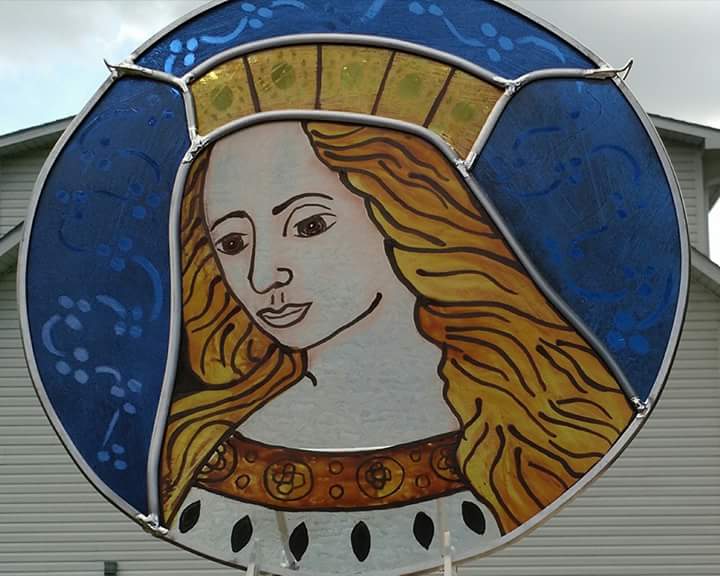
– Bietriz la Cristaliere, for stained glass

Queensprize

Queen’s Prize winning entry, made with period tools in a period fashion

TI Quest Request for TI 196 – Hints for Glassworkers

Reposted from the TI Liason:


Greetings from the editor of Tournaments Illuminated!

Our upcoming Quest article is “Hints For Glass-Workers”, with Guest Editor Cynthia Konow-Brownell / Thea Gabrielle Northernridge.

Pliny the Elder said the Phoenicians first stumbled on the secret of glass manufacture.  The Romans knew and loved it; in tinted, pieced form it graced Gothic cathedrals; in Renaissance Venice, cristallo glass set a new standard for beauty and workability.  In the Society, lamp-workers re-create glass beads from many eras and locations; glass is blown, etched, pieced in mosaics and stained glass panels, and worked in any number of beautiful ways.

Send your hints and helps for any of the glass-working arts (up to 300 words) to tieditor@sca.org by August 7 and it may be included in the 4rd Quarter 2015 Issue of Tournaments Illuminated. If you’d like to include images of your work or process, please write for photo specs.